


Trisodium Phosphate (TSP)
February 15, 2026
Cationic Polyelectrolyte
February 15, 2026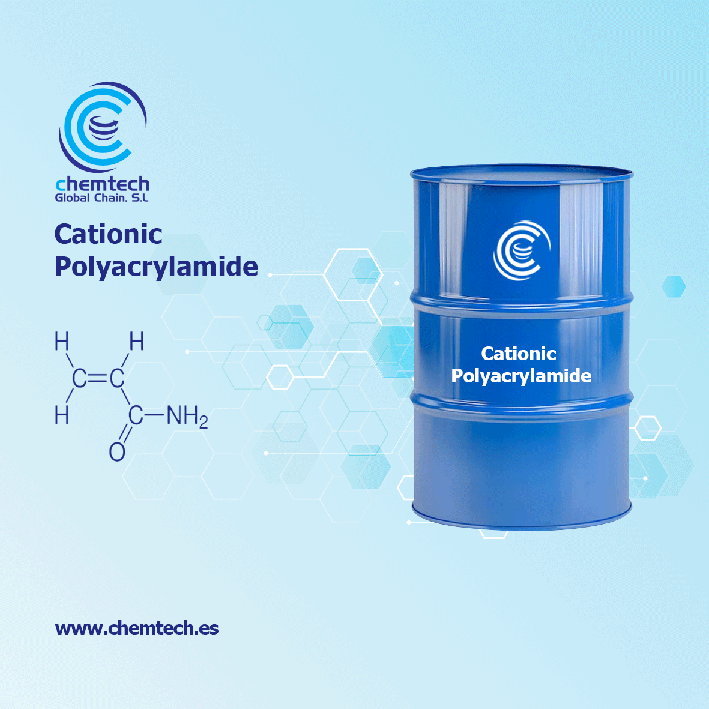
Cationic Polyacrylamide (CPAM)
Cationic Polyacrylamide (CPAM) | Industrial Chemical Trading & Supply by ChemTech
Product Overview
Cationic Polyacrylamide (CPAM) is a water-soluble polymer with a high molecular weight and a positively charged (cationic) structure.
It is one of the most widely used flocculants and coagulants in wastewater treatment, paper manufacturing, oil and gas, and textile industries.
Thanks to the presence of cationic amine groups in its molecular structure, CPAM has a strong ability to attract and bind negatively charged particles, such as organic matter and suspended solids, leading to rapid flocculation and sedimentation.
At ChemTech, a trusted chemical trading and distribution company, we supply high-quality Cationic Polyacrylamide in various industrial grades sourced from reputable global manufacturers, ensuring consistent quality and reliable performance.
Physical and Chemical Properties
| Property | Specification |
| Chemical Name: | Cationic Polyacrylamide |
| Molecular Formula: | (C₃H₅NO)ₙ |
| Ionic Type: | Positive (Cationic) |
| Appearance: | White or off-white powder |
| Solubility: | Fully soluble in water |
| Molecular Weight: | 4–12 million g/mol |
| Charge Density: | 5–80% (depending on grade) |
| Packaging: | 25 kg bags or bulk packaging |
Industrial Applications of Cationic Polyacrylamide (CPAM)
💧 1. Wastewater and Sewage Treatment
Cationic Polyacrylamide is a highly efficient flocculant and coagulant used in municipal and industrial wastewater treatment.
It effectively removes suspended solids, organic matter, and colloidal particles, improving water clarity and reducing turbidity.
CPAM is used in primary and secondary treatment processes, including sedimentation, clarification, and sludge dewatering.
🧴 2. Paper and Pulp Industry
In paper manufacturing, CPAM acts as a retention and drainage aid, improving fiber bonding, paper strength (both wet and dry), and production efficiency.
It also helps in reducing fiber loss, enhancing water recycling, and lowering chemical consumption in the papermaking process.
🏭 3. Oil, Gas, and Drilling Industry
In oilfield and drilling operations, Cationic Polyacrylamide is used as a viscosity modifier, fluid loss control agent, and borehole stabilizer.
It improves wellbore stability, minimizes fluid invasion into formations, and enhances oil recovery efficiency.
🧵 4. Textile and Dyeing Industry
CPAM is applied in the textile sector as a color-fixing agent, dye-retention aid, and flocculant for dye wastewater.
It effectively reduces water pollution, improves wastewater clarity, and supports water reuse in textile processing.
🧪 5. Chemical and Pharmaceutical Processes
In the chemical and pharmaceutical industries, Cationic Polyacrylamide functions as a phase separation agent and particle retention additive, ensuring higher process efficiency and product purity.
Key Advantages
- Excellent flocculation and clarification efficiency
- High performance in wastewater with high organic load
- Effective across a wide pH range
- Reduces usage of other coagulants (e.g., alum, PAC)
- Environmentally friendly and safe to handle
Safety and Storage
- Store in a cool, dry, and well-ventilated area away from moisture and direct sunlight.
- Avoid direct contact with skin and eyes.
- Use protective gloves, goggles, and masks during handling.
- Keep the packaging tightly closed to prevent moisture absorption.
Cationic Polyacrylamide Supply by ChemTech
ChemTech supplies Cationic Polyacrylamide (CPAM) in multiple industrial grades suitable for wastewater treatment, oil and gas operations, paper manufacturing, and textile processing.
Through our global sourcing network, we ensure competitive pricing, verified quality (COA, MSDS), and on-time delivery.
Our expert technical team provides professional support and guidance to help customers optimize their processes and improve operational efficiency.
For technical data sheets (TDS), safety data (MSDS), or pricing inquiries, please contact the ChemTech sales department today.
Related products
-
Trisodium Phosphate (TSP)
Trisodium Phosphate (TSP) | Industrial Chemical Trading and Supply by ChemTech Introduction to Trisodium Phosphate (TSP) Trisodium Phosphate (TSP), with the chemical formula Na₃PO₄, is an […]
-
Caustic Soda Flakes (Sodium Hydroxide)
Caustic Soda Flakes (Sodium Hydroxide – NaOH) | Industrial Supply and Distribution by ChemTech Introduction to Caustic Soda (Sodium Hydroxide, NaOH) Caustic Soda, also known as […]
-
Cationic Polyelectrolyte
Cationic Polyelectrolyte | Industrial Chemical Supply by ChemTech Product Overview Cationic Polyelectrolyte is a water-soluble polymer with positive charge, widely used as a flocculant and coagulant […]
Reviews
There are no reviews yet.